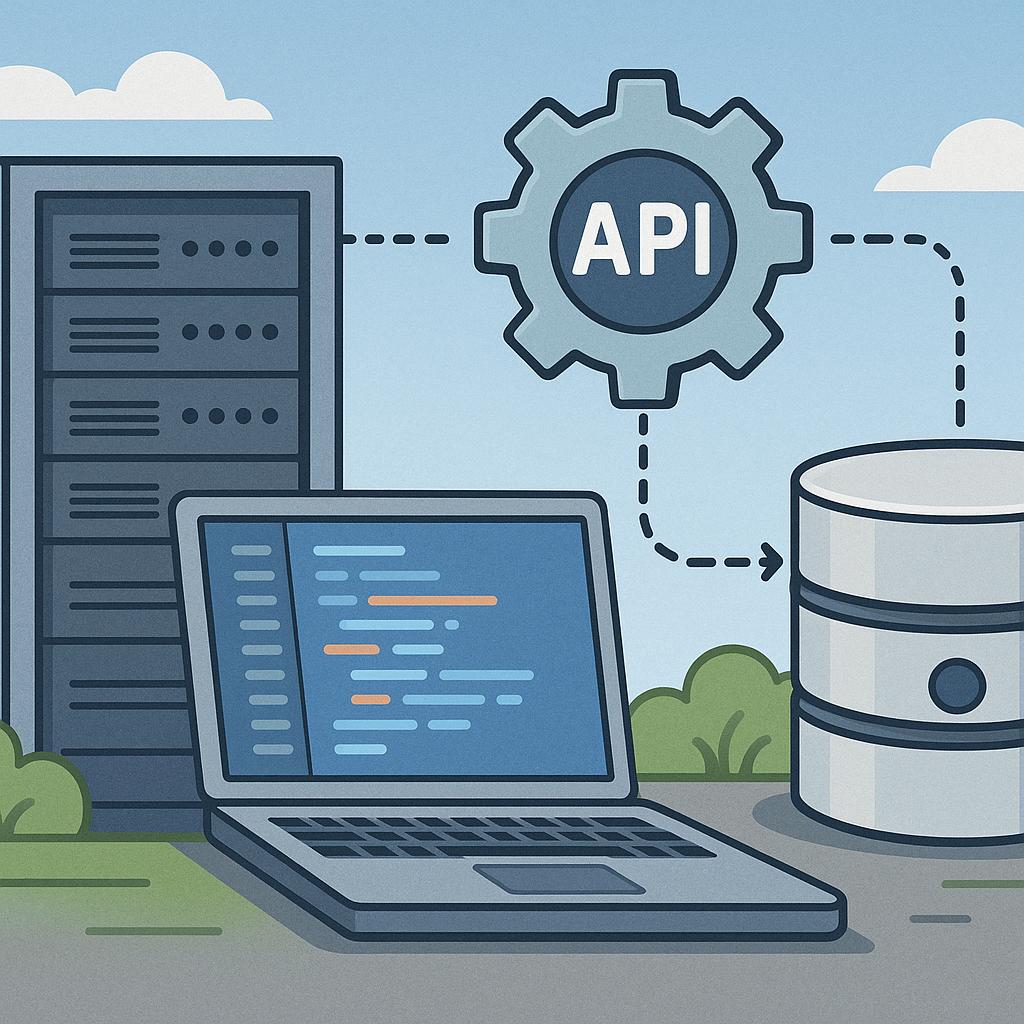
API basics for beginners
Application programming interfaces, or APIs, are the glue that lets different software components talk to one another, and a basic understanding is essential for anyone working with modern infrastructure and automation tools.
At its simplest, an API is a defined way for one programme to request data or actions from another without needing to know the internal details of how the other programme works, and that abstraction makes systems easier to build and maintain.
Commonly you will encounter web APIs that use HTTP as the transport mechanism, and these typically exchange data in formats such as JSON or XML, with JSON being the most widely used for its simplicity and readability.
- REST, which emphasises resources and standard HTTP verbs like GET and POST for interactions.
- SOAP, a more formal protocol that relies on XML and defined message structures.
- GraphQL, which allows clients to request exactly the data they need in a single query.
- gRPC, which uses binary protocols for efficient communication between services.
When you use a web API you typically send a request to an endpoint, which is a specific URL representing a resource or an action, and the API responds with a status code and a body that contains the requested data or an error message, so understanding status codes such as 200 for success or 404 for not found helps with quick diagnosis.
Methods or verbs such as GET, POST, PUT, PATCH and DELETE indicate the intent of a request, where GET reads data, POST creates or submits data, PUT and PATCH update existing data, and DELETE removes data, and consistent use of these verbs makes APIs predictable and easier to use.
Authentication and authorisation are key aspects: simple APIs may use API keys or tokens passed in headers, while more complex systems use OAuth flows to grant limited access to applications without sharing user credentials, and understanding basic security practices around secrets and tokens is important for protecting systems.
Practical tips for beginners include reading the API documentation carefully, trying requests in a tool such as Postman or with curl on the command line, and looking for example requests and sample responses; good documentation will show the required headers, parameter formats and typical error responses which speeds up learning.
Expect to encounter rate limits, which restrict how many requests you can make in a short period, and versioning, where APIs indicate breaking changes with a version number in the URL or headers so clients can migrate at their own pace, and plan your code to handle these constraints gracefully.
When you start building against an API, design your code to handle transient failures with retries, log requests and responses for debugging, validate the data structures you receive, and prefer libraries or SDKs provided by the API author to reduce boilerplate code and avoid subtle mistakes.
As you gain confidence, try combining APIs to automate simple infrastructure tasks such as provisioning resources or collecting metrics, and when you need further reading or related posts you can find more guidance in the Infrastructure category on this blog. For more builds and experiments, visit my main RC projects page.
Comments
Post a Comment