API basics for beginners: a practical checklist for infrastructure teams
APIs are the glue between systems and understanding the core ideas will help you plan, build and manage reliable services. This guide presents a practical checklist approach to the fundamentals so you can focus on the right priorities from the start. It assumes no prior knowledge beyond basic network terms and aims to be immediately useful for engineers and scrum teams working in an infrastructure context.
Start with the HTTP fundamentals since most modern APIs use the HTTP family of methods and status codes. Know the purpose of GET, POST, PUT, PATCH and DELETE and how they map to read and write operations. Use status codes correctly to indicate success, client errors and server errors, and prefer predictable, consistent responses. Choose JSON as the default payload format unless you have a specific reason to support alternatives, and document the Content-Type and Accept headers your API expects.
Authentication and authorisation are distinct and both are essential for safe operation. Authentication proves a caller is who they claim to be and can be done via API keys, OAuth2 tokens or mutual TLS depending on use case and threat model. Authorisation determines what an authenticated caller may do and should be enforced by resource-level checks rather than relying on clients. Always expire credentials, support token revocation, and minimise bearer token exposure by using short lifetimes where feasible.
Design APIs with clarity and change in mind by adopting consistent endpoint patterns and a versioning strategy. Use nouns for resources in your URI paths, keep operations idempotent where appropriate, and avoid deep nesting of resources. For versioning prefer a clear policy such as a version number in the path or using headers, and communicate deprecation windows to consumers so teams have time to migrate without breaking production traffic.
Testing, observability and error handling make an API maintainable once it is live. Provide clear, machine-readable error responses with codes and human-friendly messages to help integrators and support engineers. Implement request and error logging, expose metrics for latency and error rates, and trace transactions end to end when possible. Run automated contract tests against mock producers and consumers to validate compatibility as part of your CI pipeline.
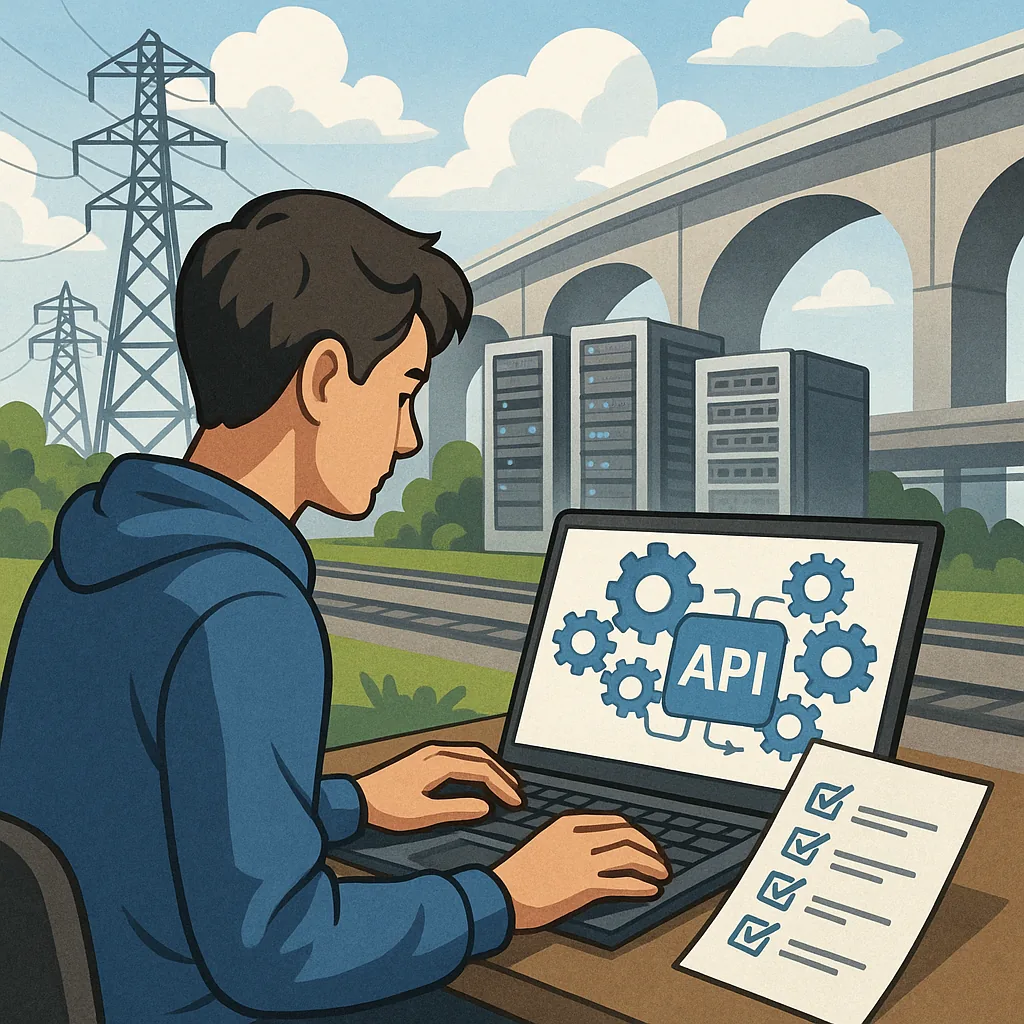
The checklist below summarises practical checkpoints you can apply when designing, building and operating an API in an infrastructure environment, and can be used as a short audit before launch.
- Define the API purpose and primary consumers to guide design choices and priorities.
- Choose a transport and payload format, and document expected headers and content types.
- Use standard HTTP methods and status codes consistently across all endpoints.
- Decide an authentication method and enforce authorisation at the resource level.
- Plan a versioning and deprecation policy with clear migration timelines.
- Provide comprehensive documentation and machine-readable schema where possible.
- Implement robust logging, metrics and distributed tracing for observability.
- Include automated contract and integration tests in CI to prevent regressions.
- Define rate limits, quotas and abuse mitigations with monitoring and alerts.
- Review security considerations such as input validation, encryption and secret management.
Keep iteration small and feedback driven; pick a minimal viable surface for your API, ship it, collect usage data and refine the design based on real consumer behaviour. Use the checklist as a routine pre-launch and post-launch review to reduce surprises and improve reliability over time. For further infrastructure-focused posts and practical guides, see the related content on the site here: Infrastructure label on Build & Automate. For more builds and experiments, visit my main RC projects page.
Comments
Post a Comment