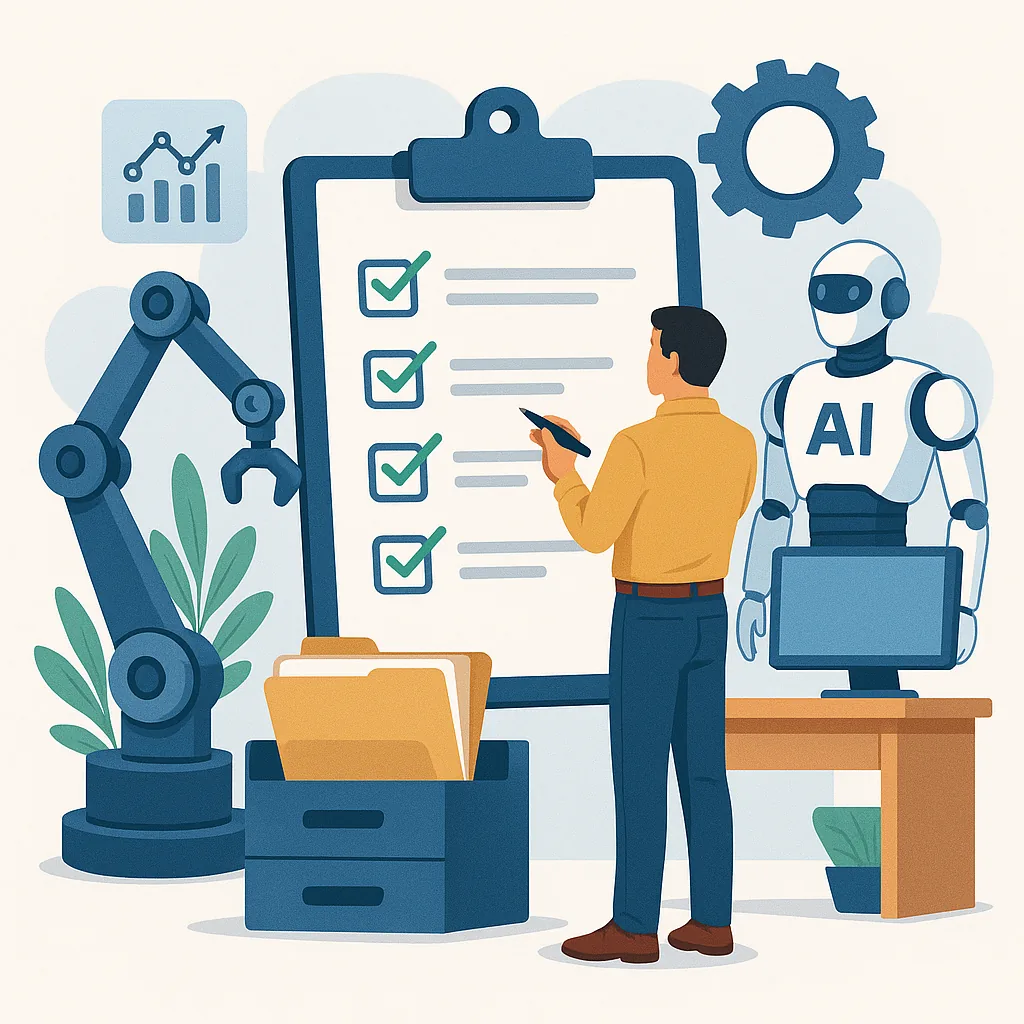
A practical checklist for automating admin tasks with AI
Automating admin tasks with AI can save time, reduce errors and free staff for higher-value work, but practical automation starts with a clear checklist and modest goals. This guide is for managers, IT staff and small-business owners who want a step-by-step approach to move from manual processes to reliable, maintainable automation. The aim is to help you prioritise tasks, choose suitable tools and manage risks so that automation delivers steady improvements rather than disruptive change.
Begin with an audit of current processes and an assessment of value and risk before you invest in tooling. Identify repetitive tasks that consume staff hours, quantify the time and error rates, and flag any regulatory or privacy constraints that affect those tasks. Consider who will own the automation once deployed and how you will measure success, and review our practical case notes and posts for ideas by visiting the AI Automation tag on this site using the link at the end of this paragraph for further background and examples: see related posts on AI Automation.
- List candidate tasks and rank by frequency and complexity.
- Map data sources and required integrations for each task.
- Identify decision points suitable for deterministic rules versus machine learning.
- Check for personally identifiable information and regulatory limits on data usage.
- Estimate time saved, cost to implement and expected error reduction.
- Designate an owner and a small pilot team for the first automations.
- Plan monitoring, rollback and manual override procedures.
Choose the right automation approach for each task rather than enforcing a single solution for everything. Use rule-based automation for straightforward, deterministic processes such as invoice routing or calendar booking, and reserve AI models for tasks that need pattern recognition, natural language understanding or predictions. If you lack in-house data science capability, consider low-code platforms, prebuilt connectors and managed AI services that simplify integration and maintenance, and keep the initial scope narrow so you can iterate quickly.
Pay close attention to data quality and governance when training or configuring AI components. Good outputs depend on clean, representative input data and appropriate labelling where applicable. Remove or obfuscate unnecessary personal data before it reaches models, document data lineage and retention policies, and maintain an audit trail of automated decisions for accountability. Define acceptance criteria for model performance and include human-in-the-loop checks during early deployment to catch edge cases and prevent degradation of user experience.
Design robust deployment and monitoring processes to ensure reliability over time. Implement automated alerting for failures, unexpected latency or drops in accuracy, and set clear escalation paths for incidents. Use version control for models and workflows, and schedule regular reviews of automation performance and cost-effectiveness. Include rollback mechanisms so that you can revert to manual processing if an automation introduces errors or compliance concerns, and set a cadence for retraining or recalibrating models when data drift occurs.
Consider change management alongside the technical checklist to increase adoption and minimise resistance. Communicate expected benefits and limitations to affected teams, provide training and documentation that explain how to interact with automations, and collect user feedback to guide improvements. Start with a pilot that demonstrates quick wins and scale up in waves, updating governance and support structures as you add more automated processes to your estate.
Final checklist before go-live: confirm owners and SLAs, validate data flows and privacy protections, test end-to-end scenarios including failure modes, enable monitoring and alerting, and prepare rollback plans and user support materials. Keep iterations small and measurable so each automation can be assessed against the original goals, and use the lessons learned to prioritise the next items on your list of opportunities to automate. For ongoing reading and example projects that match the approach described here, see the AI Automation tag on the site for additional articles and case studies. For more builds and experiments, visit my main RC projects page.
Comments
Post a Comment