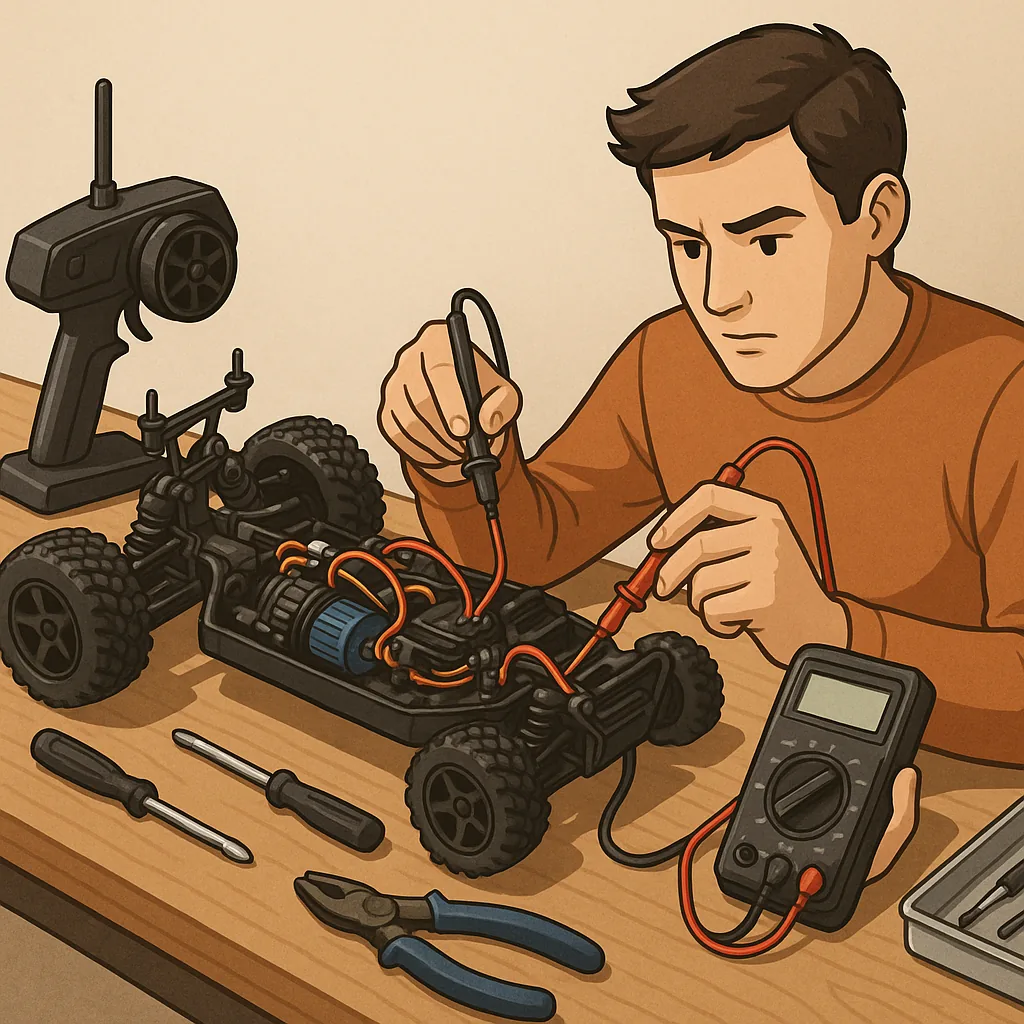
RC electronics troubleshooting: a beginner's guide for makers
Getting into RC electronics means learning to diagnose small faults as well as enjoying model building, and a calm, systematic approach will save time and money. This guide outlines straightforward checks and common causes of failure for radio-controlled models, aimed at someone new to the hobby who wants practical, repeatable steps rather than guesswork.
Start by assembling a few essential tools and observing safety basics before you touch anything. Useful items include a basic multimeter, a small soldering iron, spare connectors and heatshrink, a soft-bristle brush, and a set of hex drivers and pliers. Always remove propellers or wheels when bench-testing motors, disconnect batteries when doing soldering, and work in a well-ventilated area. Common components to inspect during troubleshooting are listed below.
- Battery and its connectors, including balance leads and discharge terminals.
- Electronic speed controller (ESC) and its BEC or regulator output.
- Receiver and its antenna, plus any telemetry modules.
- Servos, their connectors and the control horns or linkages.
- Wiring, solder joints and any inline switches or fuses.
Begin with a visual and sensory inspection of the whole system before applying power. Look for burnt components, cracked insulation, cold solder joints that look dull, or signs of water and corrosion. Smell can help: a chemical or burnt odour often points to a short or overheated part. Wiggle connectors gently to see if any are loose, and check that mechanical linkages move freely without binding. Fixing loose plugs and cleaning corrosion may resolve many issues without further measurement.
Next use the multimeter for basic electrical checks, which are the foundation of RC electronics troubleshooting. Measure the battery voltage at rest and under a small load to verify capacity and health; a single-cell LiPo should read around 4.2V fully charged and not below 3.0V under load. Check continuity on fused circuits and between motor wires where appropriate, and measure the BEC output from the ESC to ensure your receiver sees the expected 5V or 6V. Avoid testing motors with a multimeter for resistance values as the readings can be misleading; instead look for consistency between phases and for any shorts to the motor case.
If your radio system is the problem, isolate receiver and transmitter issues by testing with a known-good receiver or a bench-tested transmitter. Ensure the receiver is bound correctly to the transmitter and that failsafe settings are configured to a safe state. Antenna position matters: keep receiver and telemetry antennae clear of carbon fibre or thick metal and confirm range by walking away from the model while checking for reliable control. Intermittent control usually points to binding, antenna damage, or noisy power supplies rather than mechanical faults.
Electrical noise and grounding issues are common with motors and high-current ESCs, so use best-practice wiring to minimise interference. Keep signal wires separate from high-current cables, twist motor leads to reduce radiated noise, and fit capacitors and ferrite beads if you see random resets or jittering servos. If the ESC includes a built-in BEC and the model has many servos or a powerful motor, consider using a separate regulator or a higher-capacity BEC to prevent voltage sag. Replace suspect servo leads and test each servo independently to identify a failing unit.
Finally, adopt a workflow for fault-finding: observe, isolate, measure, repair and retest. Document what you change and test incrementally so any new fault can be attributed to a single action. If you need ideas for simple projects or want to compare notes with other beginner builds, take a look at the collection on the Maker & DIY tag to see practical examples you can follow. When a problem persists after these checks, seek advice from experienced builders or consider replacing suspect components rather than continuing to chase intermittent faults. For more builds and experiments, visit my main RC projects page.
Comments
Post a Comment