RC electronics troubleshooting: a practical guide for makers
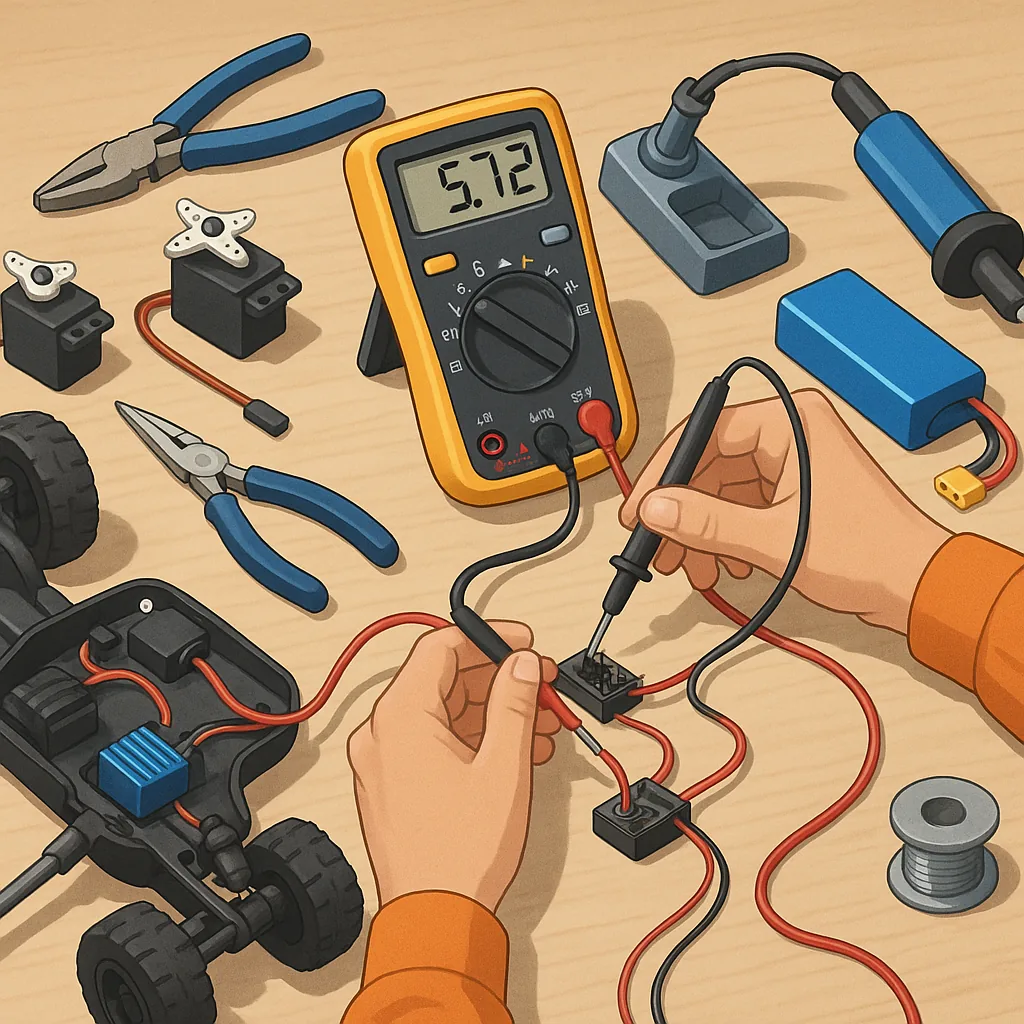
Troubleshooting RC electronics starts with a calm, methodical approach and a few essential tools, not with replacing parts at random. This guide breaks down the most common electrical faults you will meet when working on radios, receivers, ESCs, servos and power systems and offers a stepwise process you can follow on the bench or at the field. Keep a multimeter, basic soldering kit, small screwdriver set, and a servo tester or spare receiver to hand, and work in a clean, well lit space so you do not introduce new faults while fixing the old ones.
First, perform a visual and basic safety check before powering anything. Look for burnt components, melted insulation, discoloured PCBs or a lingering smell of overheated plastic. Confirm battery polarity and connector condition and ensure there is no obvious short between positive and negative terminals. Inspect wiring for chafing where it passes through bulkheads, check solder joints for dull or cracked fillets, and verify that bullet connectors and servo plugs are seated correctly. If you see corrosion on any contacts, clean and reseal them before further testing.
Next, verify the power supply under load because open‑circuit voltage alone is misleading. Measure resting cell voltage and then apply a gentle load to watch for sag that indicates a weak battery or poor connection. Check the BEC or UBEC output from your ESC to ensure it gives a stable 5 to 6 volts depending on the unit and that it can supply the current your servos demand. Look for heat on voltage regulators and confirm common ground between all electronic modules, since a missing ground is a frequent cause of intermittent operation and strange behaviour.
Signal path faults are often mistaken for power issues, so isolate them early. Confirm transmitter and receiver are bound and that failsafe settings are correct so servos go to safe positions when the link is lost. Test channels individually with a servo tester to verify PWM output, or use a known working receiver as a swap test. If your system uses digital protocols such as SBUS or DSMX, check that wiring and ports match the protocol and that any required inversion or settings are correct on the receiver and flight controller or mixer board.
Motors, ESCs and servos produce noise and heat that can mask an underlying fault, so treat these components with particular care. Inspect brush motors for worn commutators and clean them where accessible, and check brush spring tension. For brushless systems, run ESC calibration and verify throttle endpoints and brake settings are sensible. If an ESC cuts out under load, consider fitting additional electrolytic capacitors across the power input to tame voltage spikes and review the layout of power wires to reduce resistance and inductance. Servos that twitch or jitter often suffer from poor grounding, low supply voltage, or signal noise that can be remedied with ferrite beads or small decoupling capacitors.
Wiring and joints are responsible for a surprising number of faults, so adopt a systematic reflow and reseal process if you find issues. Reflow suspect solder joints with the correct temperature and fresh solder, and use flux to ensure a reliable wetting action. Replace cheap or corroded connector housings and consider soldering leads directly for high current runs with heatshrink over the joints. Maintain a single point ground strategy where practical and keep high current and signal wiring physically separated to avoid induced noise problems on control lines. For more builds and experiments, visit my main RC projects page.
Finally, adopt an isolation workflow and keep good notes so you can repeat fixes and learn from each incident. Swap components one at a time to isolate the fault, log voltages, temperatures and observed behaviour, and if a part fails repeatedly avoid reuse even if it seems functional. Update firmware on flight controllers and ESCs cautiously and only after verifying hardware integrity, and consult build logs before changing configurations. For related build examples and troubleshooting posts see our Maker & DIY tag for real world repairs and circuit layouts that often shed light on tricky faults in RC systems.
Comments
Post a Comment