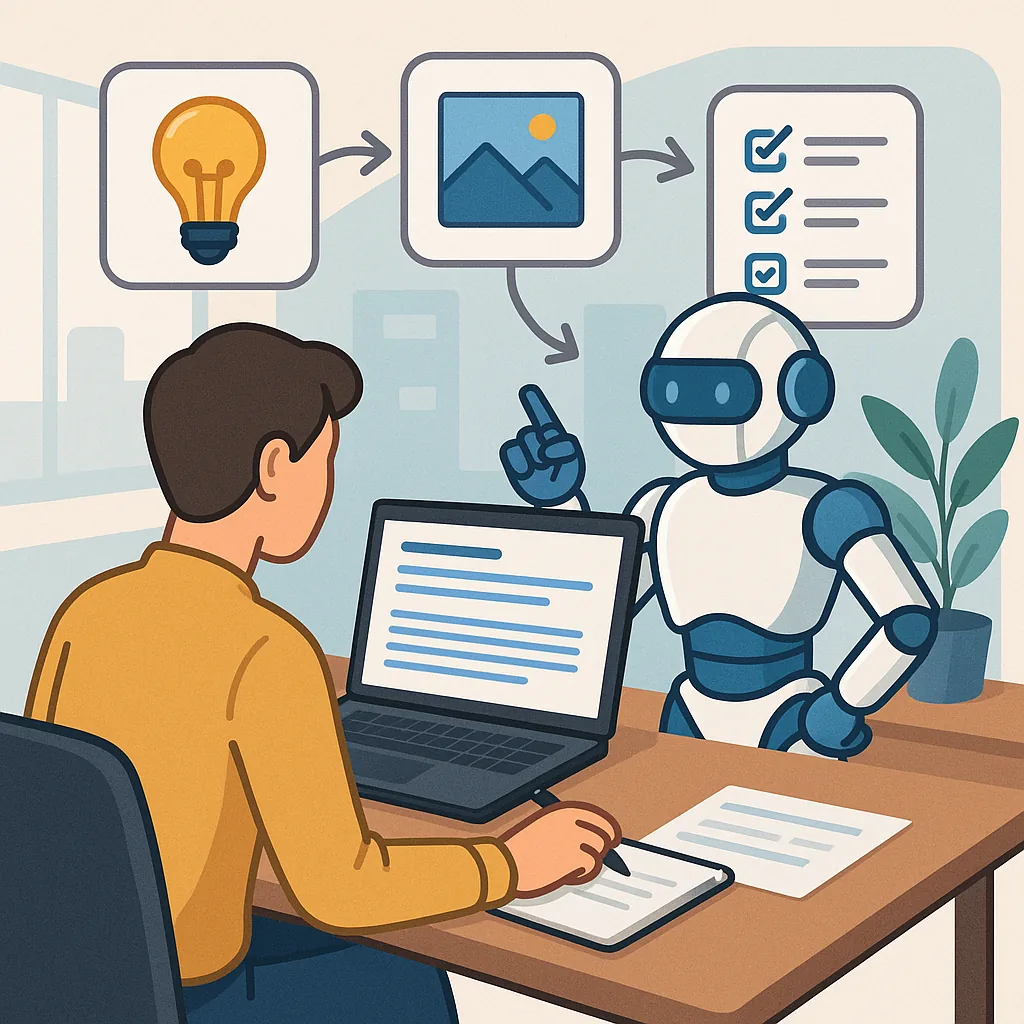
AI for content workflows (responsible): a step-by-step tutorial
This tutorial walks through a practical, responsible approach to adding AI into content workflows, suitable for small teams and in-house content operations as well as agencies using external services. The aim is to help you design incremental changes that reduce risk and preserve editorial standards, rather than attempting a wholesale replacement of human judgement. The steps assume basic familiarity with content management systems and a willingness to pilot small automations first.
Step 1 is defining clear goals and governance for the AI integration, and you should start by listing the specific tasks you want to improve and the success criteria you will measure against. Ask whether you want faster drafts, better topic discovery, improved metadata, or assistance with localisation, and set measurable targets such as time saved per article or a target reduction in factual errors. Establish high-level governance principles now, covering data privacy, attribution, and escalation paths when the AI output is questionable.
Step 2 covers data preparation and prompt design, and this is where most practical gains are made by focusing on quality rather than complexity. Create a small, representative dataset of past content to test prompts and guardrails, and develop prompt templates that include context, desired tone, and explicit constraints on unverifiable claims. Label examples of acceptable and unacceptable outputs so the team understands boundaries, and keep prompt templates in a shared repository so they can be iterated and audited.
Step 3 is selecting tools and planning integration points, and you should prioritise systems that allow clear logging, human review, and easy rollback. Choose models and vendors that support on-premises or API-based deployment according to your data sensitivity, and test several approaches: lightweight generation for ideation, extraction models for summarisation, and classification models for tagging or moderation. Build integration in stages, beginning with non-public tasks such as internal summaries or draft headlines, then expand to customer-facing content once confidence grows.
- Create a minimal viable pipeline for one content task before broad rollout.
- Log inputs and outputs for each run so you can audit decisions later.
- Define human checkpoints where an editor must sign off before publication.
- Measure both efficiency metrics and quality metrics such as factual accuracy.
- Plan regular reviews to update prompts and retrain any custom models.
Step 4 implements human-in-the-loop processes and clear editorial responsibilities, and you should design the workflow so the AI augments rather than replaces editorial judgement. For example, generate a draft outline and have an editor verify facts, sources, and tone before the piece enters the CMS for layout. Use role-based permissions in your publishing system so AI-generated sections are flagged and visible to reviewers, and keep an audit trail that records who approved changes and when. If you want further reading on practical AI usage in similar projects, see our collection of posts on the topic at our AI & Automation label.
Step 5 focuses on testing, monitoring and iteration, and you should design simple tests that run on a small set of live or near-live content to surface issues early. Monitor for hallucinations, bias, tone drift and reduction in originality, and set up alerts when quality metrics fall below threshold. Collect feedback from editors and readers and feed that back into prompt templates and training datasets. Regularly review logs to understand common failure modes and refine the human checkpoints accordingly.
To conclude, deploy incrementally, document decisions and maintain transparent records so responsibility is clear and reversible if problems arise. Start with low-risk tasks, require human sign-off for publication-sensitive content, and schedule periodic audits of both model behaviour and editorial outcomes. Responsible adoption is a continuous cycle of defining objectives, constraining outputs, verifying results and improving the process, and following this tutorial will help you introduce AI into content workflows while keeping control and quality at the centre of your operation. For more builds and experiments, visit my main RC projects page.
Comments
Post a Comment